Thursday, January 27, 2011
Civil War Cannon's description and role
"Artillery in the 1800's fought side by side with infantry units because the range of the big guns limited them to visible targets. Like the infantry weapons, Civil War-era cannon were muzzle loaders and required a crew of eight men to aim, load, and fire the weapon. Maintaining the large guns was an important job and discipline in the artillery was very strict due to the value of the weapon. One artillery unit was referred to as a battery. Composed of six cannon and just over one hundred men, the battery was commanded by a captain. Many batteries were companies of an artillery regiment. Battery A, 4th US Artillery or Battery B, 1st New York Light Artillery are examples of this. Some northern states raised "independent" batteries, which were not attached to an artillery regiment. New York supplied fifteen independent batteries including Captain Andrew Cowan's 1st New York Battery and Captain Patrick Hart's 15th New York Battery, both of which fought at Gettysburg. "

Thursday, January 20, 2011
Pre - 1800's Cannons
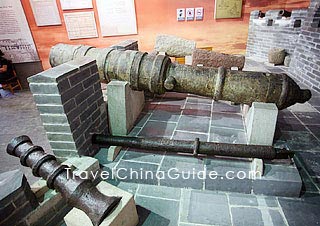
"In the Northern Song Dynasty (960-1127), gunpowder began to be used in weaponry and the earliest experience in the world. In the Compendium of Military we can determine that there were three production methods for cannonballs which were hurled by a stonejacker as in the Three Kingdoms Period.
In the Southern Song Dynasty (1127 - 1279), Records of Defending Cities by Chen Gui showed the earliest use of flame throwers. People at that time held powder in a thick bamboo tube that spewed fire out of it to burn enemies.
The shooting fire weapon Huo Chong made of metal came out in the Yuan Dynasty (1271 - 1368). It was the predecessor of firearms. When soldiers used it, they usually foisted powder into the powder chamber, fixed the powder wick and the stones, and then lit to shoot. In the following dynasty Ming (1368-1644), it played an important role in wars and was the most advanced weapon world wide. Huo Chong with larger calibre evolved to be the cannon, and the one with small caliber to be guns. |
| Iron Bombs |
Although weapons once occupied the top place, they didn't develop much further according to the Training Records (or Lian Bing Shi Ji) by Qi Jiguang cold weapons were still dominant. While after powder spread in the Western world, firearms were quickly employed and until the merchantmen of Spain and Holland brought the latest ones in the late Ming dynasty, the Chinese had not realized their lack of development. The imported cannons in the Qing Dynasty had a high reputation such as 'Great General in Red'. However in the late Qing, it fell again behind during the confrontation between westerners and Chinese."
Thursday, January 13, 2011


Cannon Designs
The early cannon designs were a vase-like shape made out of cast iron. "A smoothbore weapon is one which has a barrel without rifling" - Wikipedia. All cannons are smoothbore, so the projectile can come out more effeciently. Also, the first cannons were muzzle-loaded, which means they were loaded from the front of the barrel, not the back.
A howitzer is a type of artillery that has a short barrel and the use of small propellant charges to propel projectiles at high trajectories, with a steep angle of descent.
A mortar is a cannon that fires indirectly that fires shells at low velocities, short ranges, and high-arcing ballistic trajectories. It is typically muzzle-loading and has a barrel length less than 15 times its caliber.
The type of amuuntion today are high explosive, illuminate, white phosphorus, and armor piercing.
A howitzer is a type of artillery that has a short barrel and the use of small propellant charges to propel projectiles at high trajectories, with a steep angle of descent.
A mortar is a cannon that fires indirectly that fires shells at low velocities, short ranges, and high-arcing ballistic trajectories. It is typically muzzle-loading and has a barrel length less than 15 times its caliber.
The type of amuuntion today are high explosive, illuminate, white phosphorus, and armor piercing.
Subscribe to:
Posts (Atom)